lesson · pitch matching

Move Towards the Note

Try One Clear Note

how pitch moves

The tongue does the tuning

When you whistle with puckered lips, the opening stays roughly the same while the pitch changes. What moves is mostly your tongue. It reshapes the space inside your mouth, and that space acts like a small resonating chamber. A smaller space gives a higher note; a larger space gives a lower one.

You can feel this without whistling at all. Silently shape the vowel "oo" and then "ee". On "ee", the tongue rises and moves forward, shrinking the space. Whistle while making that same silent movement and the note will usually climb. Return towards "oo" and it falls.

This is why a steady single note is such a good foundation. Once the lips and breath are reliable, you can leave them alone and give your attention to one thing: the tongue.
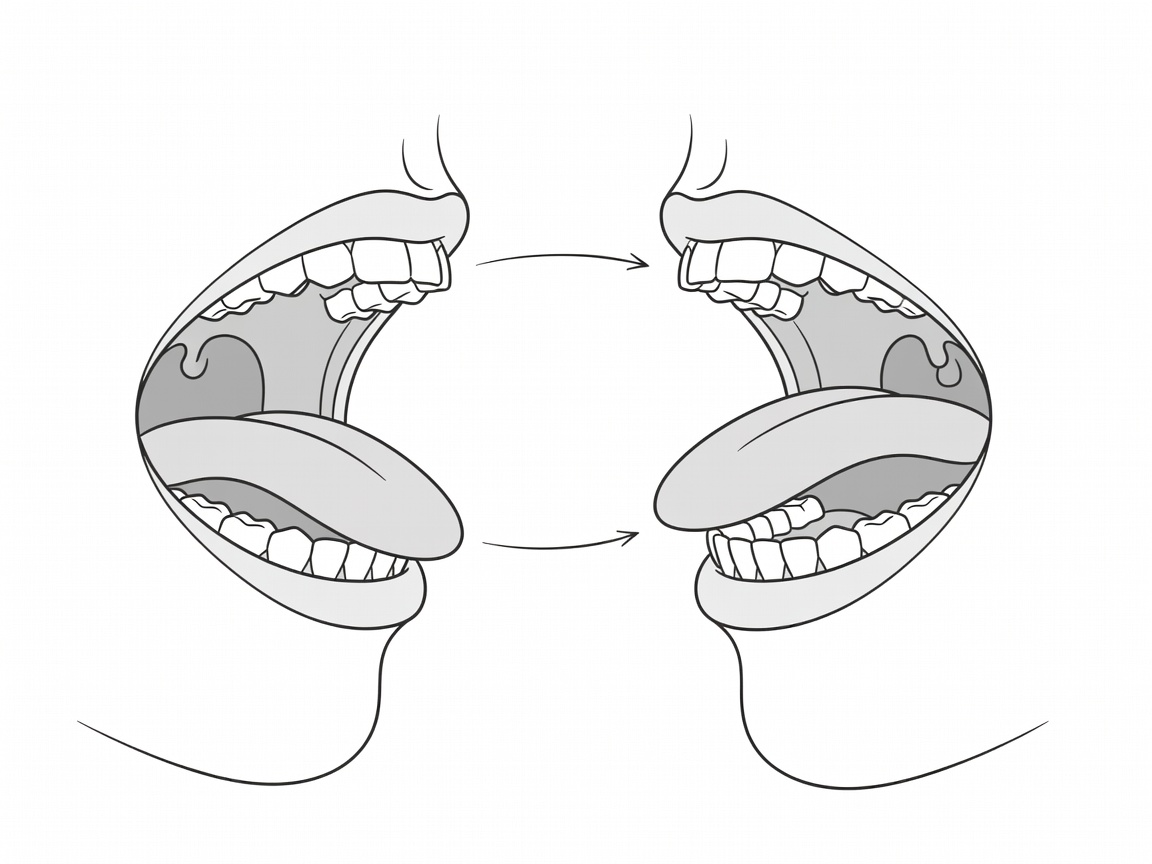

Side-view diagram of the mouth showing a low tongue for a lower note and a raised, forward tongue for a higher note
Lower tongue, larger space, lower pitch. Raised tongue, smaller space, higher pitch.

pitch-direction diagrams

Three shapes to practise

The slide

A slow, continuous rise. Glide the tongue forward without stepping.

The siren

Up and back down on one breath. Keep the airflow constant throughout.

The ladder

Three separate steps: degrees 1, 2, 3 and back. Each note sits still before moving.

matching a reference

Listen, place, adjust

To practise accuracy you need a reference: a piano or keyboard, a guitar string, or a free tuner app on your phone. Most modern instruments are tuned to the international standard in which the A above middle C sounds at 440 Hz, set out in ISO 16. You do not need to know that number to use it, but it explains why a tuner app and a piano agree.

Your whistle will usually sound higher than the reference, often by an octave or more, because a whistle naturally sits well above the voice. Matching the same note name in a higher octave still counts as matching. Choose a reference note in the middle of your whistling range rather than forcing yourself to its exact height.

  1. Listen. Play the note and let it ring for a few seconds.
  2. Imagine it. Hear it in your head, or hum it quietly.
  3. Place it. Whistle your best guess.
  4. Decide the direction. Is your note above or below? Answering this question is the core skill.
  5. Slide towards it. Move the tongue slowly until the two sounds blend. When you are close, you may hear a gentle pulsing that slows as you approach.

Please do not measure yourself against perfect, or absolute, pitch, the rare ability to name a note without any reference. What improves with practice is relative pitch: hearing whether one note is higher or lower than another and by roughly how much. That is what melodies need.

A retired man at an upright piano pressing one key and whistling to match it in a sunlit living room
One key, one breath, one honest comparison.

expandable practice

Sirens · three minutes
  1. Whistle your easiest note.
  2. Slide slowly up as far as is comfortable, then back down.
  3. Repeat five times, trying to keep the tone clear at the top and bottom.
Three-note ladder · four minutes
  1. Play three neighbouring white keys, such as C, D and E.
  2. Match each one, pausing on it before moving.
  3. Play them again and whistle them without stopping.
Echo recording · five minutes
  1. Record a reference note followed by your whistled attempt on your phone.
  2. Play it back. Was the attempt above or below?
  3. Record again with one adjustment and compare.